


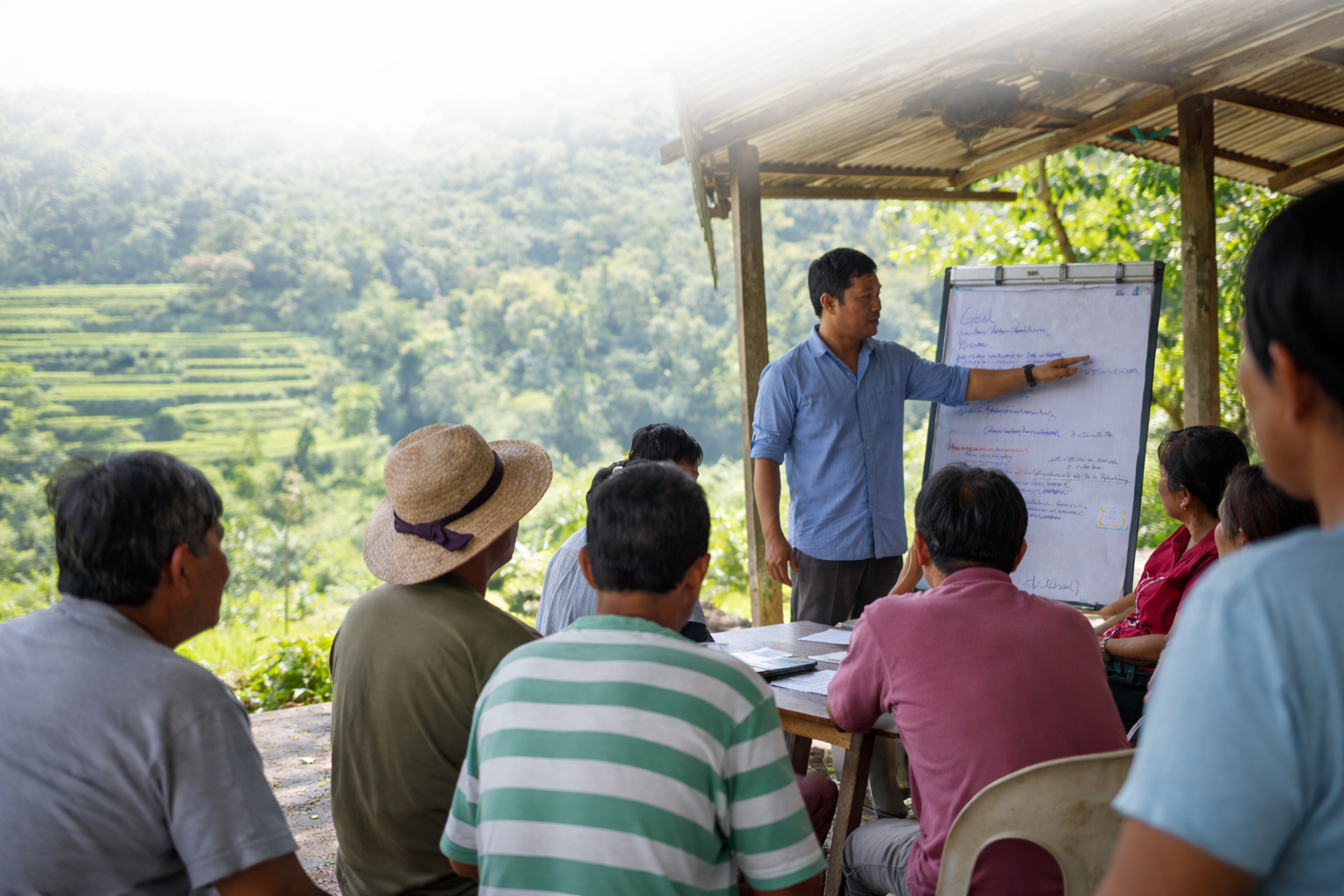
In the lush heartland of Bukidnon, where the scent of earth freshly turned still lingers in the air and the rhythm of farming sets the tempo of life, farmer cooperatives stand not merely as economic entities—but as lifelines. They carry with them the weight of collective aspiration: fairer access to markets, equitable financing, and a shared voice for farmers who, too often, are left out of critical conversations.
However, subsidies or one-time interventions are not a simple solution to the problems small cooperatives face. These are the same challenging issues that small businesses face globally: In the face of economic instability, how do we stay viable? How can we fairly and dignifiedly price our goods? How do we move from surviving the present to shaping the future?
These are not just questions of cooperative management—they are fundamentally business questions. And if we are to help cooperatives flourish, we must treat them with the seriousness and strategic intent that any enterprise deserves.
This is where the goal of business education must be found—not as a theoretical endeavor limited to textbooks or classrooms, but as a useful, community-based transforming force. It needs to develop into a decision-making compass, a problem-solving toolkit, and a link between traditional knowledge and contemporary business.
I’ve had the honor of working directly with cooperative managers, leaders, and regular farmer members at Bukidnon State University’s College of Business—people who are working to not only provide for their families but also to care for something greater than themselves. I have seen how business principles become tangible when they are taught in Binukid or Cebuano and are demonstrated via real-world problems.
I recall a woman from an Agrarian Reform Cooperative who, after a session on strategic planning, said to me, “Sa una, sige lang mi ug baligya pero wala mi plano sa umaabot.” (“We used to just sell whatever we harvested, without any real plan for the future.”) That moment stayed with me. Because suddenly, strategic thinking was no longer an academic ideal—it became a form of agency.
In another training, a young treasurer learned how to compute break-even prices for the first time. His face lit up as he said, “Dili lang mabuhi ang coop, kundi mutubo pa.” (“It’s not just about helping the coop survive—it’s about helping it grow.”) And that’s the crux of it. When farmers begin to see the beauty of numbers not as threats, but as tools for clarity and growth, a profound shift takes place.
What educators do in these communities goes far beyond teaching. It’s not outreach—it’s co creation, its collaboration in forging a better future for the underserved sector of the society. We don’t arrive with answers; we arrive to listen, to co-design, to enable and to empower. Whether we’re developing a governance manual, delivering financial literacy modules, or building costing templates from scratch, we are placing real instruments of change into the hands of those who need them most—and who know best how to use them.
And while the numbers matter, the transformation is deeper than balance sheets or business plans. It’s in the renewed confidence of a board learning how to rotate leadership roles responsibly. It’s in the courage of a member who stands up in an assembly and speaks—for the first time. It’s in the dignity of collective governance finally coming alive.
To me, this is the soul of extension work. As educators, our mission is not confined to producing degree-holders. We are here to build capacity, restore dignity, and nurture stewardship —especially in places where resources are scarce, but hope abounds.
Some of the most powerful lessons I’ve witnessed didn’t unfold in air-conditioned lecture halls, but under the shade of mango trees, inside barangay gymnasiums, in rice mills or beside drying rice fields. It’s there—in the hum of community life—that education becomes most alive. Not because it is simplified but it is made relevant.
In the end, business education is not about complexity—it is about clarity, courage, and connection. It’s about helping rural cooperatives not only to dream but to organize, to strategize and to thrive.
Because when our farmer cooperatives succeed, entire communities rise with them. And that, I believe, is a future worth building—together.
Republication Notice
This essay was originally published in Scholarly Lens, Dreamer Publishing Services. © Jake L. Peras. Reposted on this website for portfolio and educational purposes.
No responses yet