


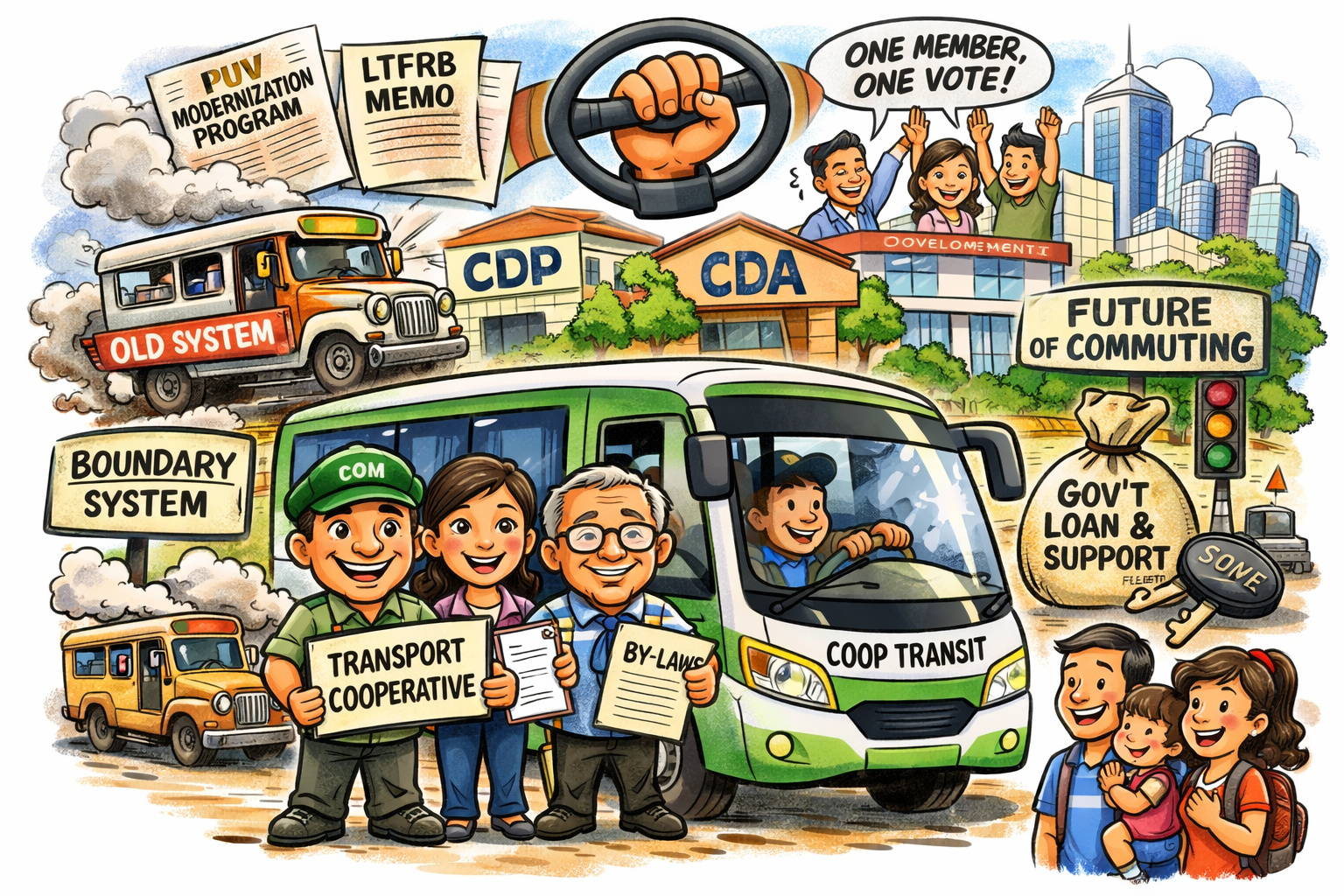
For decades, public transport in the Philippines operated largely under a system of individual operators. Jeepneys, vans, and buses were owned and managed by a single operator, while drivers worked under the boundary system—paying daily rental fees before earning any income for themselves. While this system sustained livelihoods, it also led to fragmented operations, inconsistent safety standards, and limited social protection for drivers.
In response to these challenges, the government introduced reforms that facilitated the creation of transportation cooperatives—a new institutional model intended to professionalize public transport services while protecting the welfare of drivers and operators.
The Policy Trigger: Public Utility Vehicle Modernization Program
The emergence of transportation cooperatives is closely linked to the Public Utility Vehicle Modernization Program (PUVMP) launched in 2017 by the Department of Transportation.
Key goals of the PUVMP:
- Replace old and unsafe vehicles with modern, environmentally compliant units
- Improve safety and operational standards
- Rationalize routes and reduce traffic congestion
- Professionalize the public transport sector
- Improve working conditions for drivers
The Land Transportation Franchising and Regulatory Board (LTFRB) implements the program through regulatory reforms affecting franchising, routing, and fleet operations.
Why Cooperatives Became the Preferred Model
Under modernization policies, operators were encouraged to consolidate into cooperatives or corporations. The cooperative model became widely adopted because it:
- promotes democratic ownership (one member, one vote),
- protects small operators from displacement,
- allows collective ownership of modern vehicles,
- improves access to financing and government support,
- strengthens bargaining power and operational stability.
Drivers are not merely workers in this system—they can become member-owners and decision-makers.
Key Laws and Policies Supporting Transportation Cooperatives
The formation of transportation cooperatives is grounded in several national laws, regulations, and policy issuances:
1. Republic Act No. 9520 (Philippine Cooperative Code of 2008)
This law provides the legal framework for the creation, registration, and governance of cooperatives in the Philippines. Transportation cooperatives are registered and regulated under the Cooperative Development Authority.
2. Executive Order No. 202 (1987)
Created the Land Transportation Franchising and Regulatory Board, which regulates routes, fares, and franchises for public land transport.
3. Public Utility Vehicle Modernization Program (2017)
Institutionalized transport modernization and encouraged consolidation into cooperatives or corporations to improve service efficiency and accountability.
4. LTFRB Memorandum Circulars on Consolidation
Various LTFRB circulars require route-based consolidation of individual operators into juridical entities (cooperatives or corporations) as a prerequisite for franchise issuance.
5. Department Order No. 2017-011 (DOTr)
Provides the guidelines for implementing the PUV Modernization Program, including industry consolidation and fleet management systems.
6. Local Government Ordinances and Local Public Transport Route Plans (LPTRPs)
Local government units develop route rationalization plans consistent with modernization policies. These plans determine the routes and service areas in which transport cooperatives operate.
From Boundary System to Fleet Management
One of the most significant reforms introduced through transport cooperatives is the shift from the traditional boundary system to a fleet-managed transport service.
Under the new system:
- vehicles are centrally managed,
- drivers receive fixed wages and benefits,
- maintenance schedules are standardized,
- dispatching and monitoring systems improve reliability and safety.
This transition transforms public transport from an informal livelihood structure into a professionalized service system.
Benefits for Drivers, Passengers, and Communities
For Drivers and Operators
- more stable income and social protection
- access to financing, insurance, and training
- participation in decision-making
For Passengers
- safer and more comfortable vehicles
- predictable routes and schedules
- improved service quality
For Communities
- organized and efficient transport systems
- reduced road disorder
- lower emissions and environmental impact
Challenges in the Transition
Despite its advantages, the shift toward transportation cooperatives presents ongoing challenges:
- governance and management capacity gaps
- financial sustainability and loan repayment pressures
- resistance to organizational change
- the need for strong member discipline and unity
These challenges indicate that many transport cooperatives remain at an institutional-strengthening and professional-development stage.
A Collective Future for Public Transport
Transportation cooperatives represent more than a regulatory requirement—they embody a shift toward collective responsibility, professional management, and social protection in public transport.
Their long-term success depends on sustained cooperation among government agencies, local governments, cooperative leaders, drivers, and the commuting public.
As the country continues to modernize its transport system, transportation cooperatives serve as a model for inclusive development, in which mobility services are not only efficient but also equitable and community-centered.
2 Responses
Thank you for this eye opening insight about transportation cooperatives.
Thank you for your kind words. I’m glad you found the discussion insightful. Transportation cooperatives play a critical role in strengthening local economies and improving service delivery, and informed conversations like this help advance their development. I appreciate you taking the time to engage.