


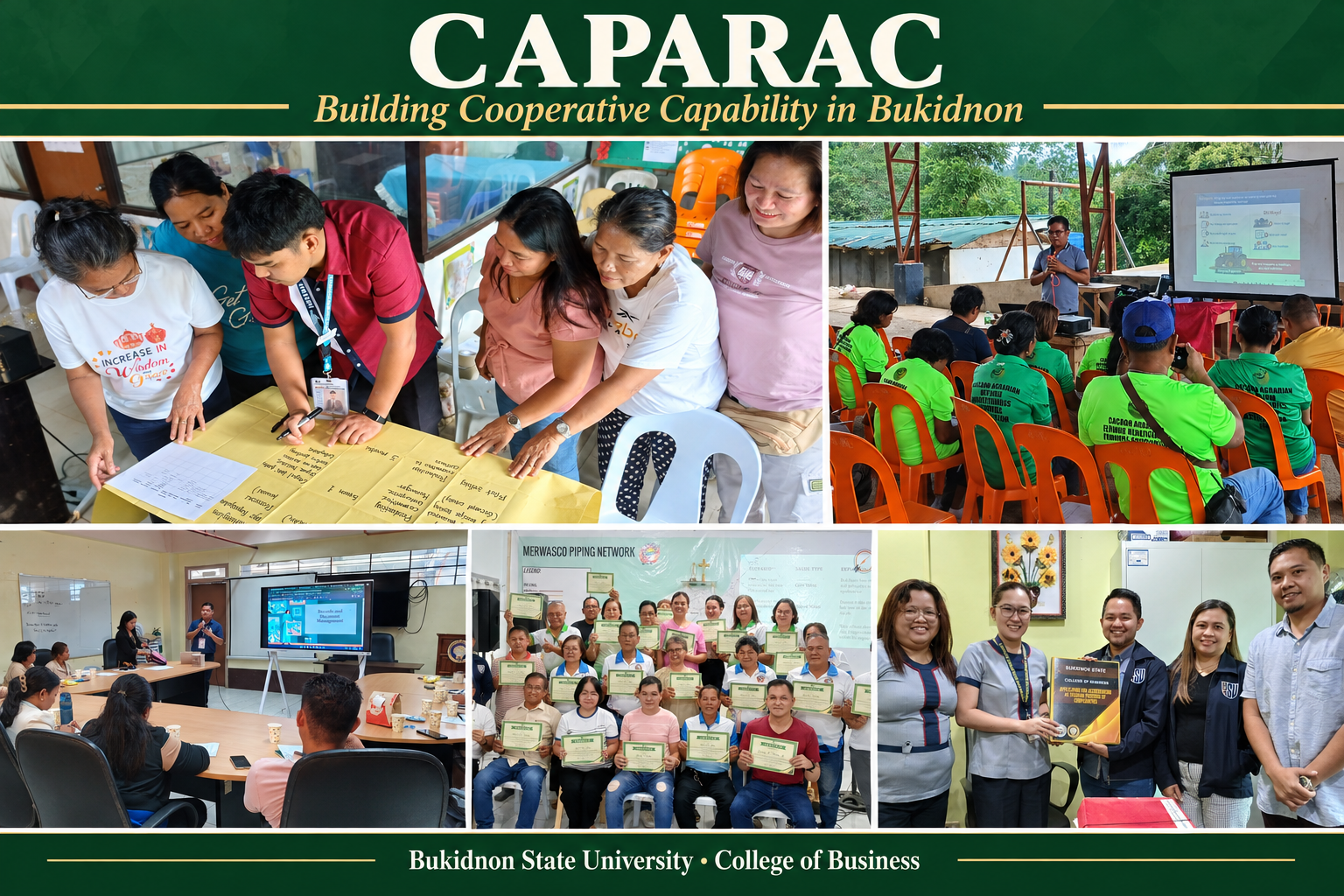
For an agrarian reform cooperative, the ability to keep accurate records, safeguard collective funds, make accountable decisions, and plan its operations affects the services its members can receive. These responsibilities connect organizational management with the welfare of people who have entrusted their resources and aspirations to a shared enterprise. The Cooperativism Among Provincial Agrarian Reform Associations and Cooperatives (CAPARAC): A Capability-Building Program addresses this connection. Its contribution lies in providing practical education and technical assistance that help rural organizations build the capabilities needed to fulfill their responsibilities to members.
Implemented by the College of Business of Bukidnon State University under the leadership of Jake L. Peras, in partnership with the Department of Agrarian Reform–Bukidnon Provincial Office, CAPARAC responds to a consequential development challenge: access to resources and opportunities must be supported by the ability to manage them. Cooperative officers need sound financial judgment. Boards need clear policies and a workable organizational direction. Members need to understand their rights, obligations, and role in collective decisions. By addressing these needs together, CAPARAC connects university extension with the practical conditions that support cooperative continuity and member service.
The initiative’s sustained implementation is a significant accomplishment. Its 2023–2025 records report 2,578 trainee participations or attendance, while the consolidated reports for January–June 2026 document a further 53 activity entries and 1,239 participant attendances. These figures include repeated participation and describe the extent of service delivery. Their significance lies in the continuing availability of support across several years and management functions. Cooperative capability requires opportunities to revisit problems, develop related skills, and apply learning as organizational responsibilities evolve.
CAPARAC’s training content reflects this understanding. Cooperative fundamentals establish the purpose of member ownership and democratic participation. Governance education clarifies the responsibilities of boards, officers, and committees. Bookkeeping, records management, audit, and internal control address how transactions are documented and resources protected. Strategic planning, entrepreneurship, costing, and financial management connect organizational direction with business decisions. Credit literacy and microfinance education address the responsibilities associated with borrowing and lending. Together, these interventions provide a practical foundation for managing a cooperative as both a member-owned organization and an economic enterprise.
The development value of these subjects becomes clearer when viewed through the decisions cooperatives face. Accurate records give officers a basis for explaining how funds have been used. Clear policies provide a consistent basis for transactions and responsibilities. Costing informs judgments about whether an enterprise can sustain its operations. Strategic planning helps a board connect priorities with available resources and assigned tasks. CAPARAC provides learning opportunities around these functions, placing business and management knowledge within the everyday work of cooperative leadership.
Documented engagements illustrate how the project connects related organizational needs. Audit management and policy formulation activities at GKCPAR addressed accountability and the rules that guide operations. Strategic planning and policy formulation at BARBA-MPC linked organizational direction with governance instruments. Entrepreneurship and financial management activities at KFARC brought business development and resource management into a connected learning process. These examples show the practical logic of CAPARAC’s approach: organizational functions depend on one another, and assistance becomes more useful when those relationships are addressed.
The initiative also brings university expertise closer to agrarian reform communities. Faculty knowledge is translated into training, workshops, and technical assistance that participants can relate to their own organizational concerns. Consultation and DAR field coordination help connect academic resources with participating cooperatives. Favorable evaluations across the implementation records indicate that participants valued the relevance and delivery of this support. Those assessments provide evidence of a responsive learning experience and a basis for continuing engagement.
The BukSU–DAR partnership gives CAPARAC an institutional structure capable of supporting recurring delivery. BukSU contributes faculty expertise and instructional resources; DAR contributes field coordination, participant mobilization, and logistical support; participating organizations provide the experience and concerns that shape the work. The records also document faculty service without university honoraria and DAR support for food and snacks. These contributions demonstrate the commitment behind implementation. Sustaining that commitment through appropriate faculty support and documented partner arrangements will be important to the initiative’s continuity.
CAPARAC has also helped establish a platform for continuing cooperative education. BukSU’s accreditation as a Cooperative Development Authority Certified Training Provider, together with reusable modules, training designs, and accumulated faculty experience, strengthens the institution’s ability to serve the sector. The project records document recognition through the Best Extension Project Award in the Governance and Management Category, DAR recognitions, and first-place recognition as an Outstanding ASEAN SDG Project in the Prosperity Category at the ACES Summit 2025. These milestones reinforce the initiative’s credibility and visibility, complementing the evidence of sustained implementation.
Its strongest documented contributions to sustainable development concern practical education, governance support, and partnership. These relate directly to the purposes of SDG 4 on Quality Education, SDG 16 on Peace, Justice and Strong Institutions, and SDG 17 on Partnerships for the Goals. Financial and enterprise interventions also provide an enabling pathway toward stronger economic activity and member services. The significance of this alignment lies in the functions CAPARAC addresses: people need relevant skills, organizations need accountable systems, and continuing support requires institutions that can work together.
The next measure of CAPARAC’s impact is what participating cooperatives carry into their operations after an engagement. A draft policy gains organizational value when it is approved and consistently used. A strategic plan becomes consequential when responsibilities, resources, and progress reviews follow. Financial education becomes useful when it informs records, transactions, and decisions. The current evidence establishes substantial delivery, favorable participant appraisal, practical assistance, and institutional capacity. Follow-up verification can show how these accomplishments develop into sustained organizational practices and measurable benefits for members, including any longer-term changes in enterprise performance or household welfare.
CAPARAC has established a substantive foundation for that progression. It has sustained access to cooperative education, mobilized academic and government support, and addressed management responsibilities that matter to rural organizations. Its enduring development value will grow as participating cooperatives preserve and apply this learning through leadership changes and daily operations. In that continuing work, CAPARAC advances a meaningful purpose of university extension: helping communities build organizations capable of managing their own affairs and serving the people who depend on them.
No responses yet