


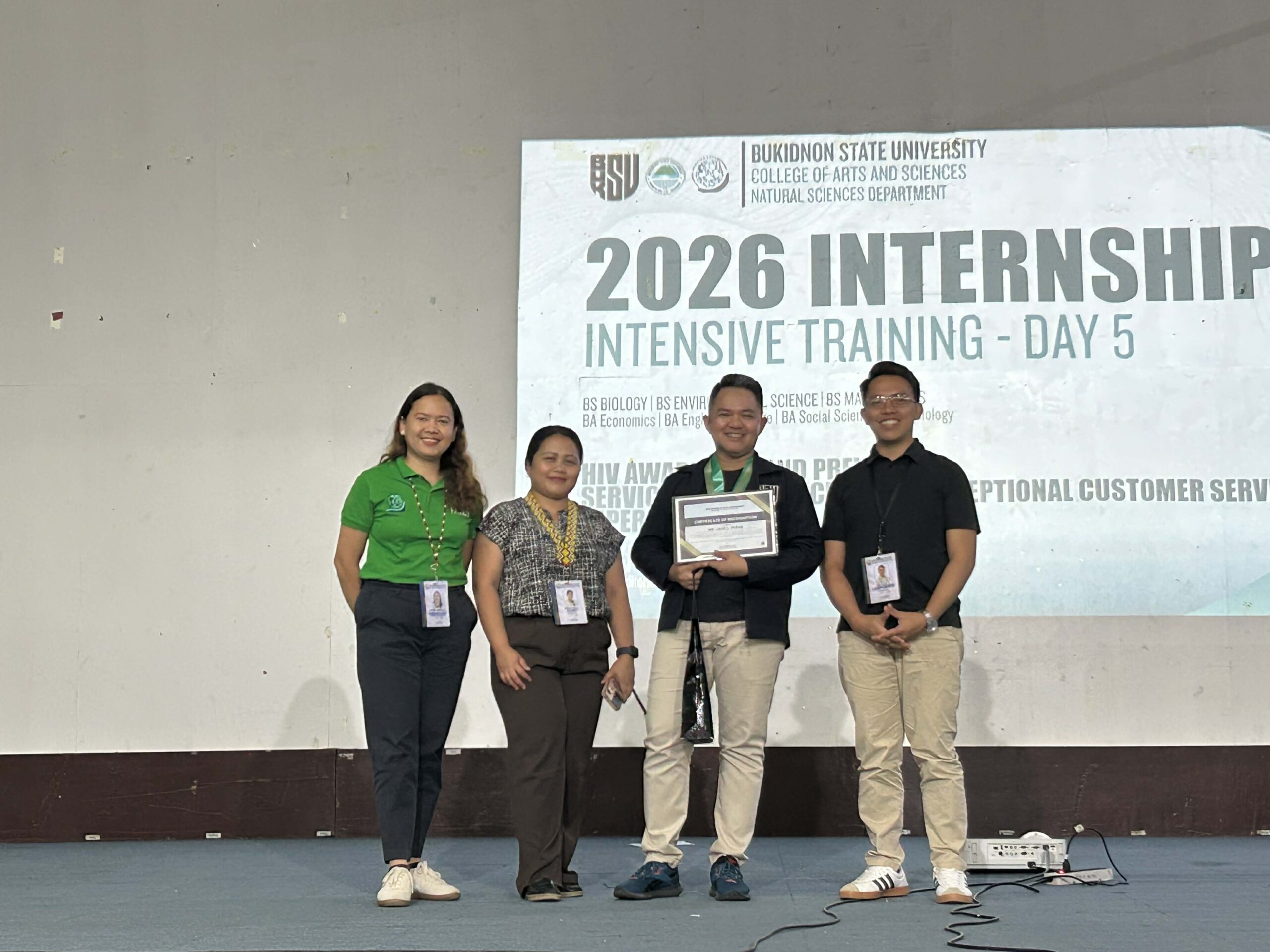
I walked into the room carrying what looked like a simple presentation slide about customer service, a few scripts, and a handful of reminders meant to prepare student interns for their deployment. But I knew from the start that this session could not be ordinary. These were not just students attending a seminar. They were young professionals standing at the edge of their first real exposure to institutional life, public offices, private organizations, systems, protocols, and expectations that cannot be learned from textbooks alone.
In front of me were students from the College of Arts and Sciences, individuals trained to think critically, communicate thoughtfully, and interpret the human condition through multiple lenses. Soon, they would be deployed to host institutions where performance is measured not only by what one knows, but by how one behaves under pressure, how one speaks when confused, and how one responds when someone depends on them.
That day, I did not begin by defining customer service. I started by asking a question.
“Who here wants to be absorbed or recommended after the internship?”
Hands rose some confidently, others with hesitation. I smiled because the answer was already clear. Every intern wants to be remembered for excellence. Every intern wants to be trusted. Every intern wants to finish the experience not only with completion papers, but with a reputation strong enough to open doors.
Then I said the one line I wanted them to carry into every workplace they would enter:
Customer service is the one skill that makes you valuable in any department—public or private.
That statement often surprises people, because many still think customer service belongs only to front desks and call centers. But in real institutions, customer service is not a department. It is a professional mindset. It is not simply being “nice.” It is the ability to protect time, reduce stress, and build trust with other people—consistently.
And consistency, I reminded them, is what separates interns who are merely present from those who are truly dependable.
As I spoke, I could see the shift happening. Some were nodding. Some were writing. Others were quietly reflecting because deep down, they knew that the workplace is not just a place where tasks are completed. It is a place where relationships are built, reputations are formed, and careers quietly begin.
I explained that internships function as extended job interviews. Organizations may not remember a student’s GPA or the titles of their courses, but they will remember something far more practical: reliability, attitude, communication, responsiveness, and respect.
Then I gave them a framing statement that felt almost like a warning—but also a promise:
Your technical skills may get you into an organization, but your customer service skills will determine how you are remembered.
To make the concept more tangible, I offered a simple formula:
Customer service = Trust + Clarity + Speed + Respect.
The room became more attentive when I explained that “customers” are not only buyers. Interns serve external customers—clients, guests, students, patients, visitors—but they also serve internal customers: supervisors, co-interns, office staff, managers, and faculty.
And in that moment, I emphasized a truth that many interns only realize when it is already too late:
Most interns fail not because of incompetence, but because they neglect internal customer service.
They don’t update their supervisors. They disappear when deadlines approach. They respond late. They become defensive. They act casual too early. They underestimate how quickly trust can be damaged, and how difficult it is to rebuild once broken.
From there, I introduced what I called their Intern Service Code—the five behaviors that win in every workplace.
First, be present. Not just physically, but mentally. Eye contact, attention, note-taking, and the discipline to put the phone away. Because presence is respect in action.
Second, be clear. I reminded them that clarity is kindness, and confusion is costly. A good intern communicates in complete sentences: what they did, what they need, when they will deliver, and when they will update.
Third, be reliable. Trust is built when you deliver—even on small things. A single missed deadline can erase ten good impressions.
Fourth, be proactive. Don’t wait to be chased. Anticipate next steps. Ask how you can help. Because the best interns don’t add work—they remove work.
And fifth, be respectful under pressure. Interns will face busy supervisors, impatient clients, strict systems, and hierarchy. That is where professionalism is tested—not when things are easy, but when they are inconvenient.
I paused after that, letting the message settle. Because if there is one thing that separates a student’s mindset from a professional’s mindset, it is emotional discipline. The workplace does not reward the loudest voice. It rewards the calmest competence.
To equip them with something they could actually use on Day 1, I shared a framework simple enough to remember even under stress: the 3Rs of Service.
Receive. Respond. Resolve.
Receive—listen fully and clarify.
Respond—acknowledge and take ownership of the next step.
Resolve—give a timeline, update, and close the loop.
Then I told them something I’ve learned from experience:
Customers do not demand perfection. They demand clarity and effort.
It was vital for them to hear that, because many interns freeze when they don’t know what to do. They panic when they lack answers. They fear mistakes so much that they choose silence instead of responsibility.
So, I gave them scripts—real words to use in real situations.
If you don’t know the answer, don’t guess. Don’t stop at “I don’t know.” Say:
“Thank you for your question. I don’t want to give incorrect information. May I verify this and get back to you within ten minutes?”
If a client is upset, don’t escalate. Don’t say “calm down” or “that’s not my fault.” Say:
“I understand this is frustrating. Thank you for informing us. Let me check what happened, and I will update you shortly.”
If you made a mistake, don’t cover it up. Own it and correct it. I told them plainly:
A mistake is forgivable. A cover-up is career-ending.
If you are overloaded with tasks, don’t complain—clarify priorities. Say:
“I can finish Task A by 3 PM and Task B by tomorrow morning. Which one should I prioritize first?”
And if you need to follow up professionally, do it with respect:
“Good day. I’m following up on my message regarding [topic]. May I ask if there are updates or next steps I should proceed with?”
As I delivered those lines, I realized something: these students were not only learning customer service; they were learning to be customer service. They were learning self-leadership. They were learning the discipline of becoming dependable.
Toward the end of the session, I gave them a warning list—seven intern mistakes that quickly destroy trust: being late without notice, seeing-zoning messages, failing to update, overpromising, being defensive, gossiping, and acting casual too early.
Then I offered them a final truth, the kind that stays in the mind longer than any slide:
Competence gets attention. Character earns trust.
I ended the talk with the message I wanted them to carry into every office, every hallway, every front desk, every meeting room, and every day of their deployment:
Your internship is not only training. It is your audition.
The simplest way to stand out is this: be the intern who makes work lighter, not heavier.
And before I stepped away from the microphone, I gave them one last mantra—short, sharp, and unforgettable:
Be easy to work with. Be quick to respond. Be safe to trust.
Walking out of that session, I felt grateful. Not because I delivered a lecture, but because I witnessed a moment of transformation. In that room, students were preparing to enter the real world—not as “just interns,” but as professionals in formation.
And if they truly apply what they learned, I know this: wherever they are deployed—public or private—they will not be ignored. They will not be forgotten.
Because the world always remembers people who bring clarity, respect, and trust wherever they go.
One response
I still remember how, even as a student intern, I witnessed customer service at its finest. Embracing that principle early on shaped the way I carried myself professionally, and it has guided my entire career ever since. I remain grateful to Professor Peras for the wisdom and real‑world insight he shared with us before our deployment—lessons that continue to make a difference in my journey.